Follow the Product’s Storage and Timing Guidance
Good storage can reduce avoidable exposure, but it cannot guarantee that a perfume remains unchanged indefinitely. Follow its label and manufacturer guidance rather than assigning every fragrance the same temperature, humidity or lifespan.
CHANEL’s fragrance-care guidance advises keeping its fragrance bottles away from heat and light and tightly sealed. That is a useful practical reference, not evidence that every perfume has the same stability limits.
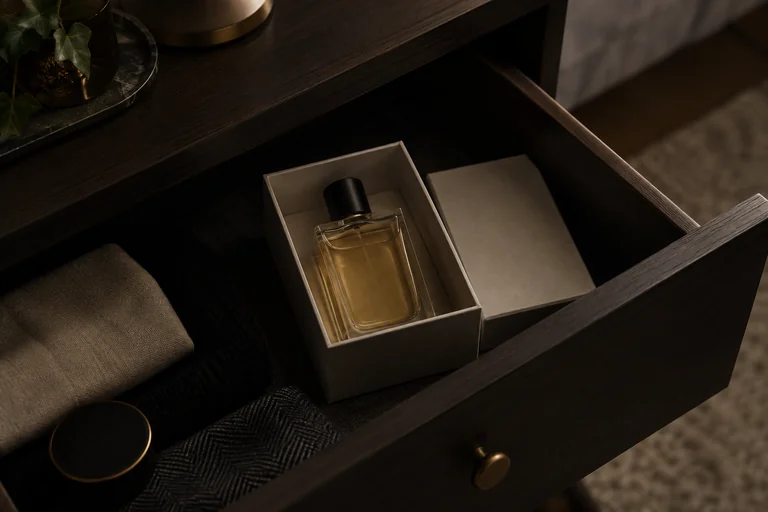
Choose a Suitable Storage Spot
Look at the conditions in the actual place: direct sunlight, a radiator, a hot car or another heat source are more informative than the room’s name. An interior drawer or cabinet can provide a useful protected home if it follows the product’s requirements.
An opaque box can help keep light off the bottle, but it does not shield it from a hot location. Dark glass likewise does not establish adequate storage by itself. Keep the closure secure and the container in good condition.
Do not use a refrigerator or freezer as a universal preservation method. If special storage is needed, obtain guidance for that product. This guide has no verified basis for a 60–70°F target, 80°F rejection point or 60% humidity threshold.
Keep Handling Simple
The original usable container avoids an unnecessary transfer. If using a documented refill or compatible travel system, follow its instructions, fill limits and cleaning guidance. Do not top up an unidentified container or fill nearly to the brim based on a generic headspace rule.
Keep track of the exact product and relevant opening or transfer dates. That record helps you interpret its printed guidance; it does not create a universal expiry date. The label-reading guide explains batch codes and period-after-opening marks.
Separate Changed Scent From a Home Safety Verdict
FDA’s shelf-life guidance explains that shelf life depends on product, use and storage, and that temperature changes, sunlight and air can affect cosmetics. U.S. cosmetics do not generally require a printed expiration date; that absence is not a promise of unlimited safe life.
A sour smell, unexpected color change or foreign material is a reason to stop and investigate, not to test the product on skin to establish safety. FDA’s general consumer guidance advises discarding cosmetics with changes in color or smell and reporting product problems.
An ordinary alcohol impression in the opening is not by itself a reliable spoilage diagnosis. Conversely, a pleasant dry-down does not clear an altered product as safe. Ask the manufacturer about an unexpected change rather than using a 30-second sniff rule.
Check the Package Separately
| Observation | Useful action | Conclusion to avoid |
|---|---|---|
| Leaking collar or loose closure | Stop carrying it and ask about the package | Leak proves the liquid has chemically spoiled |
| Changed spray pattern | Check permitted maintenance or contact support | Weak mist proves top-note deterioration |
| Unexpected liquid change | Stop use and seek product-specific guidance | Color alone supplies a diagnosis |
| Unknown storage history | Acknowledge the uncertainty when buying | A pristine box proves good storage |
Prevent an Avoidable Problem
As an illustrative storage choice, a boxed bottle on a sunny, warm windowsill remains exposed to heat. Moving it to a suitable interior cabinet addresses that exposure more directly than buying another decorative box.
Choose amount from wanted use and available storage, without assuming woody or amber perfume can tolerate neglect or citrus needs a different universal timetable. The storage-solution guide covers selecting the actual storage arrangement.