A summer fragrance plan should account for the commute, the destination and how you will carry the bottle. The temperature alone cannot tell you whether to use one, two or three sprays, and “outdoors” is not an instruction to apply more.
Use the checklist to review the constraints separately. It does not calculate a safe dose or predict how a perfume will project on your skin.
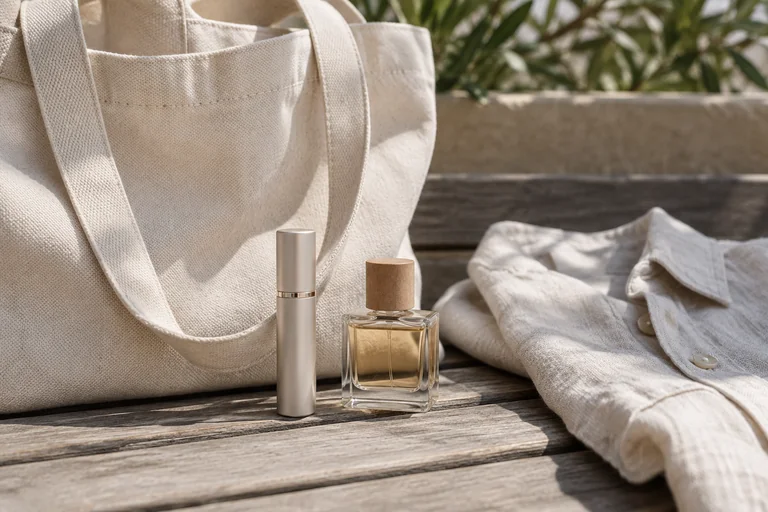
Write down the full route
| Day plan | Useful check | Avoid this assumption |
|---|---|---|
| Hot commute to an air-conditioned office | Shared transport and workplace fragrance requirements | A cool destination cancels the shared journey |
| Outdoor lunch followed by a car ride | Preferences of the people in both settings | Extra outdoor application will disappear before the ride |
| Beach, pool or sport | Whether fragrance serves any useful purpose that day | Perfume is sweat-proof, waterproof or part of sun protection |
| Long event with indoor and outdoor stages | Whether your familiar routine works across the actual itinerary | A stronger concentration is automatically needed |
| Short errand | Whether carrying or refreshing fragrance is necessary | Every outing needs a travel spray |
Respect a fragrance-free requirement rather than trying to comply with a quieter perfume. The requirement applies to the product’s presence, not only to where you spray it.
Use what you know about the exact fragrance
An atomizer’s spray output and the formula both matter. A count copied from someone else’s bottle is not a controlled dose. Follow the product directions and use your prior experience with that exact version; do not escalate because the opening seems faint to you.
The familiar summer lists of citrus, tea and light florals can help describe smells you might enjoy. They do not establish that every such perfume is subtle, that vanilla is unsuitable, or that a note family has a predictable response at a particular temperature.
IFRA’s explanation of concentration terminology makes clear that EDT, EDP and extrait are general descriptors with no strict universal definitions. None is a temperature rating. If you like your existing fragrance in summer, a seasonal label is not a reason to replace it.
Plan storage as carefully as wearing
Do not leave a fragrance baking in a parked car or in direct sun on a picnic table. Follow the maker’s storage instructions. For example, Chanel advises keeping its fragrance bottles away from heat and light and tightly sealed .
Carry only what you need in a suitable closed container. A factory travel spray avoids decanting; a refillable atomizer needs compatible filling instructions and a sound closure. Neither is an insulated storage device. If the day offers no suitable place for a bottle, leaving it at home is a reasonable choice.
Skin, clothing and sun protection are different decisions
Do not apply fragrance to irritated or sunburned skin. Follow warnings on the specific product, particularly any sun-exposure directions. A beach-themed name does not supply SPF, and a hair or body mist is not a substitute for sunscreen.
Avoid treating clothing as an automatic solution. Pale linen, dyes, trims and fabric finishes may respond differently; the perfume and garment instructions must both support the use. Spraying from farther away does not establish compatibility or prevent staining. The sweater and textile guide explains why a fabric label alone is insufficient evidence.
Decide whether a later touch-up is needed
Reassess the setting and people first. Do not spray in a shared car, public transport, at a table or around people who have not agreed to it. Your own inability to notice the perfume does not measure what remains.
For a long day, a touch-up can remain an option rather than a commitment. For swimming or exercise, skipping perfume may simplify the plan. The aim is a routine you enjoy without unsupported promises about lasting through sweat, heat or water. This is an editorial planning guide; we have not measured summer wear for the products you own.